- Trailer front and corner transitions
- Long sidewalls and crosswind-exposed surfaces
- Trailer underbody, axle, and wheel-wake regions
- Roof, side, and lower rear separation edges
- Rear doors and low-pressure base-wake zone
Application Domain 11
Heavy Trucking & Logistics
Investigating governed trailer surfaces for wake control, highway efficiency, and more stable crosswind response.
Research-stage application · performance validation pending
Application Thesis
A governed architecture—not a universal surface treatment.
DDM treats cell geometry, spacing, orientation, density, and placement as application-dependent variables. Candidate configurations must be tuned to the local flow regime, surface geometry, operating envelope, materials, and performance objective.
Public descriptions communicate the research hypothesis and validation strategy. Detailed geometry ranges, configuration logic, and application-specific design rules remain controlled technical information.
Complete Visual Reference
View the full application overview sheet.
The complete sheet brings the application regions, candidate outcomes, flow mechanisms, design variables, materials, integration paths, and validation roadmap together in one technical visual.
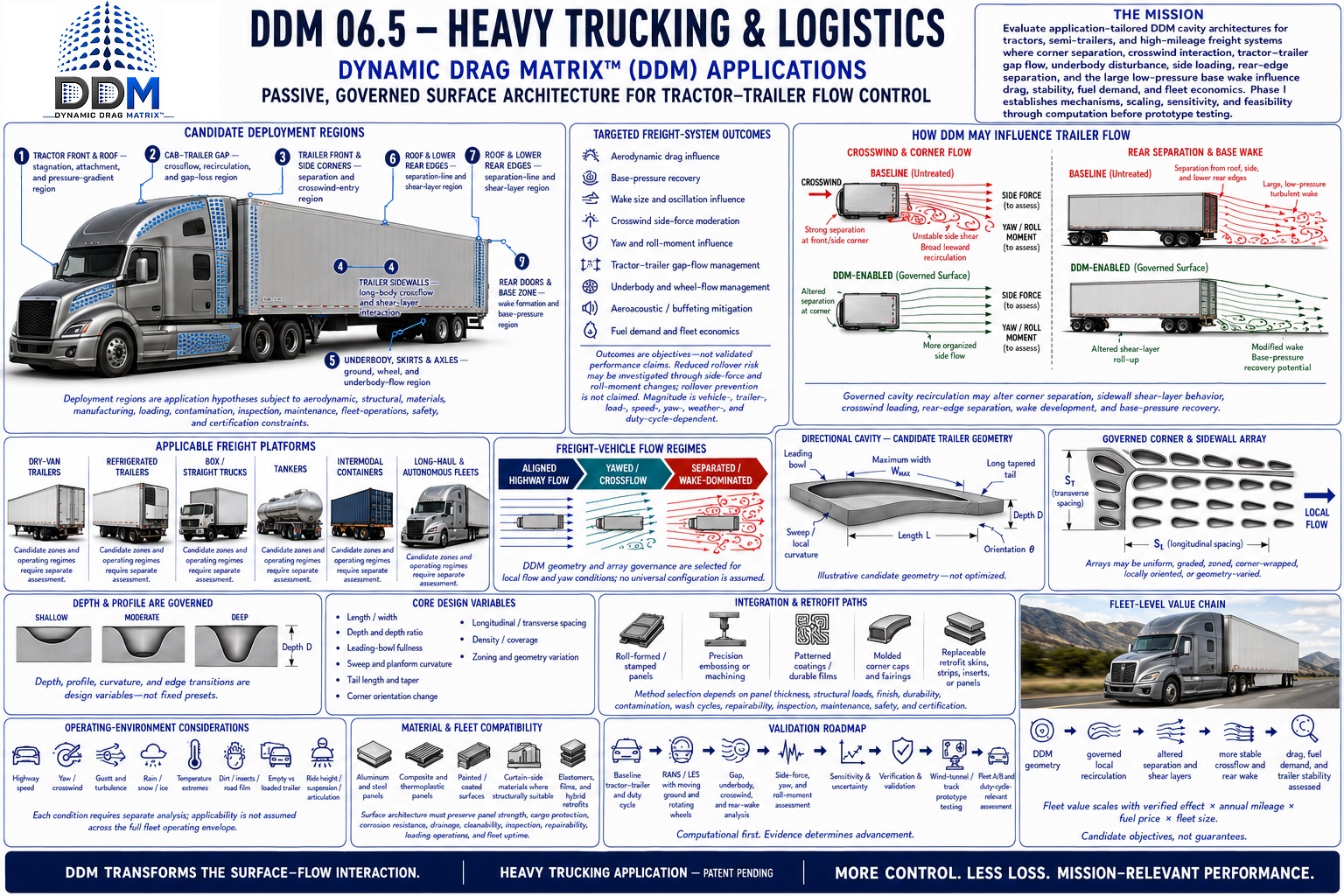 Click the sheet to open the full-resolution view ↗
Potential if Validated
Govern the air around the trailer—not only the tractor pulling it.
A highway trailer presents large crosswind-exposed sidewalls, sharp separation edges, complex underbody flow, and a persistent low-pressure wake. DDM is investigating whether zoned directional cavities can influence those flow structures to reduce verified aerodynamic losses and moderate unsteady force and moment response.
Organize local interaction
Tune cavity geometry, orientation, spacing, and density for the distinct flow approaching corners, sidewalls, underbody hardware, and rear edges.
Alter separation and wake
Measure base pressure, wake size and oscillation, side force, yaw moment, aerodynamic roll moment, drag, lift, and sensitivity to changing wind angle.
Translate verified effects
Convert supported tractor-trailer results into fuel use, emissions, stability margin, driver workload, component durability, and lifecycle operating cost.
Where DDM Could Apply
A high-mileage platform with many distinct freight geometries.
DDM would not use one universal trailer pattern. Each body type, tractor pairing, load condition, operating speed, and duty cycle requires its own zonal design and validation envelope.
Long-haul dry vans
High-mileage box trailers where rear pressure drag, tractor-trailer gap flow, crosswinds, contamination, and cumulative fuel use dominate the opportunity.
Refrigerated trailers
Reefers combining bluff-body aerodynamics with cooling demand, front-mounted equipment, underbody hardware, and strict uptime requirements.
Tankers & bulk carriers
Cylindrical and specialty bodies requiring geometry-specific treatment of crossflow, appendage wakes, side force, and rollover-sensitive operating conditions.
Delivery & regional fleets
Box trucks and short-haul trailers exposed to frequent speed changes, urban winds, loading variation, docking damage, and stop-and-go duty cycles.
Intermodal & container freight
Container chassis and transferable freight bodies where DDM concepts must tolerate dimensional variation, handling, stacking, and globally distributed maintenance.
Specialized heavy transport
Car carriers, livestock trailers, flatbeds, and oversize-load systems with open, porous, or changing geometries that require mission-specific flow studies.
Representative Deployment Zones
Five regions govern the trailer's aerodynamic opportunity.
- A
Front face and tractor-trailer gapGap recirculation, incoming-flow conditioning, corner loading, and sensitivity to tractor geometry and spacing.
- B
Leading corners and roof shouldersSeparation onset, crossflow organization, pressure distribution, and the beginning of sidewall and roof shear layers.
- C
Sidewalls and crosswind zonesUnsteady side pressure, separated crossflow, yaw response, and aerodynamic roll demand under changing wind angle.
- D
Underbody, wheels, and axlesGround interaction, suspension and axle wakes, spray, debris, lift, drag, and interaction with skirts or other devices.
- E
Rear edges and base-wake zoneRoof, side, and lower-edge separation; wake vortex formation; base-pressure recovery; oscillation; and pressure drag.
Stability Opportunity
Reduce aerodynamic demand—not promise an untippable trailer.
If DDM measurably reduces unsteady side force or aerodynamic roll moment, it may contribute to greater crosswind stability and lower rollover exposure in defined conditions. Vehicle speed, wind gusts, road curvature, steering input, tire forces, suspension, center of gravity, cargo distribution, braking, and driver response remain part of the complete stability problem.
CDdrag and highway energy demand
CYcrosswind side-force response
Claerodynamic roll-moment response
The DDM Validation Gate
Trucking value must survive real roads, real weather, and real freight.
DDM must first demonstrate repeatable changes in local flow and pressure, then quantify complete tractor-trailer drag and stability across speed, yaw, gusts, ride height, tractor-trailer gap, wheel rotation, loading, trailer type, road proximity, rain, spray, ice, dirt, damage, manufacturing tolerance, and interaction with skirts, tails, mudflaps, refrigeration equipment, and other installed hardware. Validation should progress from CFD and wind-tunnel testing to instrumented track and statistically controlled fleet trials.
Authoritative Benchmarks & Calculation Basis
EPA SmartWay — Verified Trailer AerodynamicsEPA reports that verified trailer aerodynamic devices can save up to 9% in fuel use, establishing the commercial importance of validated trailer drag reduction without predicting DDM performance.Open official source ↗EPA — Highway Drag-to-Fuel TranslationEPA cites a DOE benchmark in which a 10% reduction in aerodynamic drag corresponds to about 5.5% highway fuel savings, demonstrating that drag reduction and fuel savings are not one-to-one.Open official source ↗EPA — Diesel CO₂ Emission FactorEPA lists 10.21 kg of combustion CO₂ per gallon of diesel fuel; that factor drives the illustrative emissions calculations below.Open official source ↗
Fleet arithmetic: 2 million gal/year baseline × modeled truck-level improvement; economic value uses $4.00/gal; combustion CO₂ uses EPA's 10.21 kg/gal diesel factor and is rounded to the nearest metric ton. All percentages are DDM research thresholds, not achieved performance.
Research Questions
What must be established before performance can be claimed.
Can zoned DDM arrays alter trailer separation and improve base-pressure recovery without creating new losses elsewhere?
Can controlled crossflow reduce unsteady side force, yaw moment, or aerodynamic roll demand across realistic wind conditions?
Which effects persist through tractor-trailer gap changes, loading, yaw, rain, dirt, damage, and fleet maintenance?
Validation Path
From application hypothesis to defensible evidence.
- 01
Map tractor-trailer flow and crosswind load cases
- 02
Screen corner, sidewall, underbody, and rear-edge arrays
- 03
Quantify drag, wake, side-force, yaw, and roll-moment response
- 04
Advance supported configurations to wind-tunnel, track, and fleet testing
Evidence status
No application-specific performance figures are presented here as demonstrated results. Quantitative claims will be published only when supported by traceable computational or experimental evidence and clearly stated boundary conditions.
Application-Specific Collaboration
Evaluate alignment with this research domain.
DDM welcomes conversations with government programs, laboratories, universities, OEMs, and technical partners.
Discuss this application