- Wing and control surfaces
- Fuselage skins
- Nacelles and pylons
- UAV and advanced-air-mobility platforms
Application Domain 01
Aerospace Skins & Wings
Researching governed surface architectures for aircraft boundary-layer management.
Research-stage application · performance validation pending
Application Thesis
A governed architecture—not a universal surface treatment.
DDM treats cell geometry, spacing, orientation, density, and placement as application-dependent variables. Candidate configurations must be tuned to the local flow regime, surface geometry, operating envelope, materials, and performance objective.
Public descriptions communicate the research hypothesis and validation strategy. Detailed geometry ranges, configuration logic, and application-specific design rules remain controlled technical information.
Complete Visual Reference
View the full application overview sheet.
The complete sheet brings the application regions, candidate outcomes, flow mechanisms, design variables, materials, integration paths, and validation roadmap together in one technical visual.
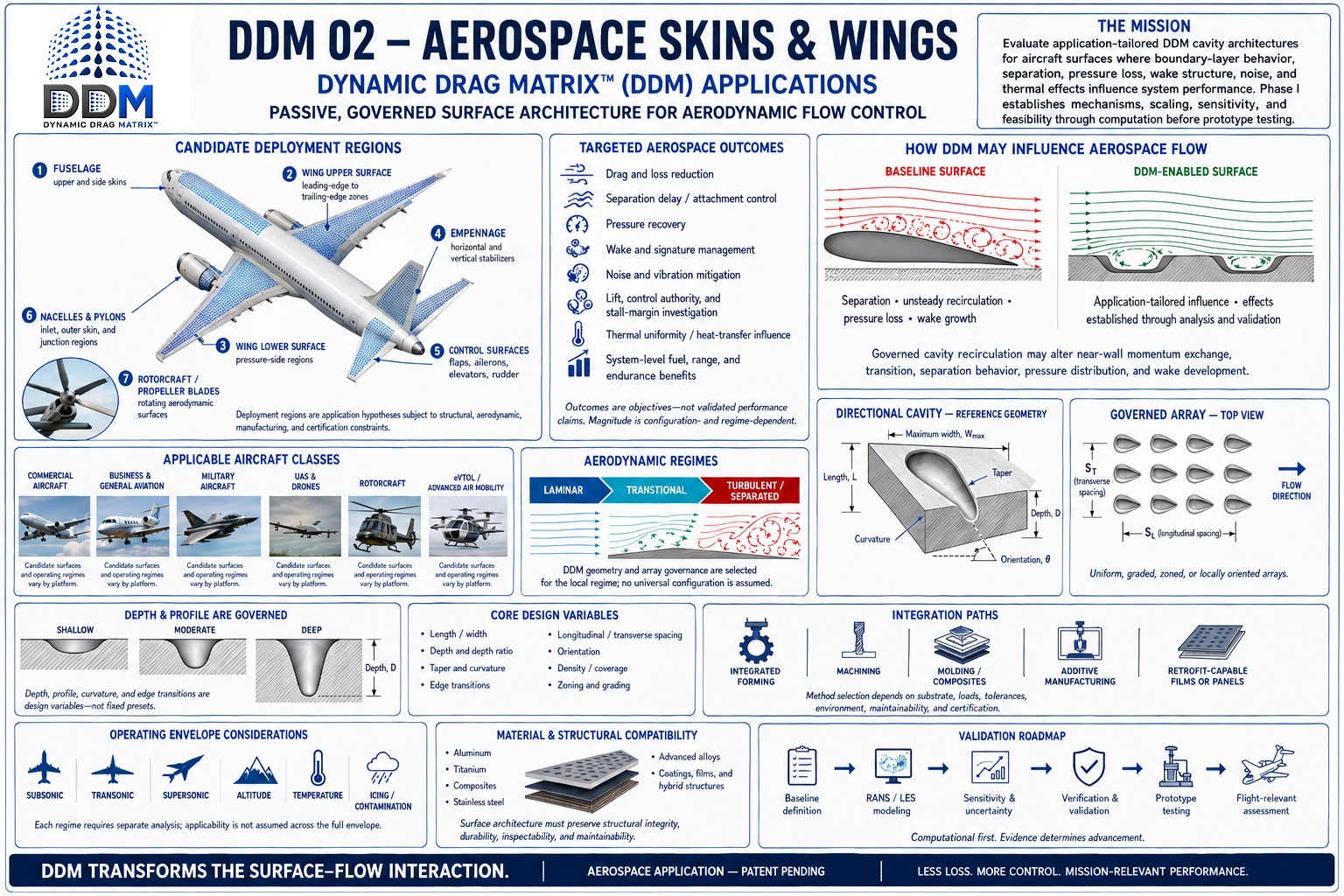 Click the sheet to open the full-resolution view ↗
Potential if Validated
Small aerodynamic gains can create fleet-scale value.
DDM is investigating whether governed surface architectures can influence local attachment, separation, wake behavior, and pressure recovery. If those effects survive aircraft-level integration, even a single-digit efficiency improvement could carry meaningful operational value.
Govern local flow
Test whether tuned cell geometry changes near-wall recirculation, separation, pressure distribution, or wake structure.
Reduce verified losses
Measure treated-region and total-aircraft drag, lift-to-drag ratio, stability, acoustic response, and off-design penalties.
Translate the result
Convert validated aircraft-level changes into mission fuel, emissions, noise, maintenance, and economic outcomes.
Illustrative Opportunity Model
What aircraft-level fuel improvement could mean.
Assumed operating case: 10 million gallons of annual jet-fuel use at an illustrative $2.50 per gallon. These are conditional calculations—not measured DDM results, a fuel-price forecast, or a guarantee of aircraft-level performance.
Conservative threshold
1%
aircraft-level fuel-burn improvement
- Fuel avoided annually
- 100,000 gal
- Illustrative annual value
- $250,000
- Combustion CO₂ avoided
- 975 metric tons
Target threshold
3%
aircraft-level fuel-burn improvement
- Fuel avoided annually
- 300,000 gal
- Illustrative annual value
- $750,000
- Combustion CO₂ avoided
- 2,925 metric tons
High-impact threshold
5%
aircraft-level fuel-burn improvement
- Fuel avoided annually
- 500,000 gal
- Illustrative annual value
- $1.25 million
- Combustion CO₂ avoided
- 4,875 metric tons
Acoustic Opportunity
Decibels are logarithmic. A modest number can represent a major physical change.
If DDM testing demonstrates a reduction in a defined acoustic measurement at the same operating condition, a 3 dB reduction corresponds to roughly 50% less sound power, 6 dB to 75% less, and 10 dB to 90% less. Perceived loudness, certification metrics, and community-noise footprints require separate application-specific analysis.
−3 dB≈ 50% less sound power
−6 dB≈ 75% less sound power
−10 dB≈ 90% less sound power
The DDM Validation Gate
The percentages are thresholds to pursue—not results already achieved.
DDM must first demonstrate repeatable local-flow improvement, then quantify total-aircraft effects across relevant Reynolds and Mach regimes, surface curvature, contamination, icing exposure, structural constraints, and the full operating envelope. Only supported aircraft-level results should be translated into mission or fleet projections.
Authoritative Benchmarks & Calculation Basis
Boeing 737 MAX — aerodynamic improvementsBoeing reports up to 1% fuel and emissions savings from aft-body aerodynamic improvements and up to 2% from advanced winglets.Open official source ↗FAA CLEEN aircraft-technology resultsFAA-reported programs include 0.4–1%, 1%, and 3.5% fuel-burn improvements, demonstrating the value of incremental aircraft-efficiency gains.Open official source ↗EPA greenhouse-gas emission factorsEPA lists 9.75 kg of combustion CO₂ per gallon of kerosene-type jet fuel; that factor drives the scenario calculations below.Open official source ↗
Scenario arithmetic: annual baseline × modeled improvement; economic value uses $2.50/gal; combustion CO₂ uses EPA's 9.75 kg/gal factor and is rounded to the nearest metric ton.
Research Questions
What must be established before performance can be claimed.
Can governed geometry delay separation without imposing an unacceptable drag penalty elsewhere in the operating envelope?
Which combinations of depth, spacing, orientation, and local surface curvature remain effective across relevant Reynolds and Mach regimes?
How do contamination, coatings, erosion, icing exposure, and maintenance cycles affect performance and durability?
Validation Path
From application hypothesis to defensible evidence.
- 01
Establish smooth-surface computational baselines
- 02
Run application-specific parametric CFD studies
- 03
Map sensitivity, uncertainty, and operating limits
- 04
Advance supported configurations toward coupon and wind-tunnel testing
Evidence status
No application-specific performance figures are presented here as demonstrated results. Quantitative claims will be published only when supported by traceable computational or experimental evidence and clearly stated boundary conditions.
Application-Specific Collaboration
Evaluate alignment with this research domain.
DDM welcomes conversations with government programs, laboratories, universities, OEMs, and technical partners.
Discuss this application